Siemens Campus, Stadtquartier Süd, Erlangen
Siemens Campus – A New City District
The Siemens Campus is transforming from a purely research and business location into a true urban neighborhood — a place where people not only work, but also live, exercise, sit in the sun, take part in civic life, water their plants, start families and, in the best sense, simply feel at home. Everything essential — housing, work, education, leisure and recreation — is within easy walking distance, no more than fifteen minutes away. The southern quarter completes the campus, turning it into a fully-fledged part of the city. The idea behind the Siemens Campus is not a conventional mixed-use development, but a composition of specialized zones — research, production, education and teaching — complemented by residential areas and a large public park.
Hard Shell – Green Core
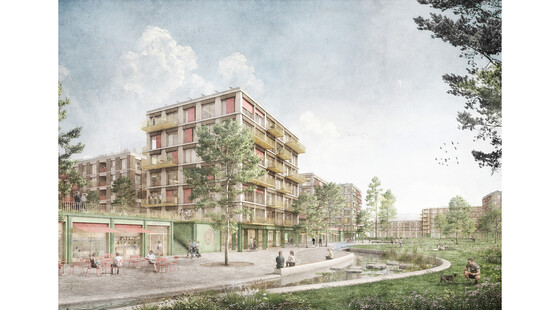
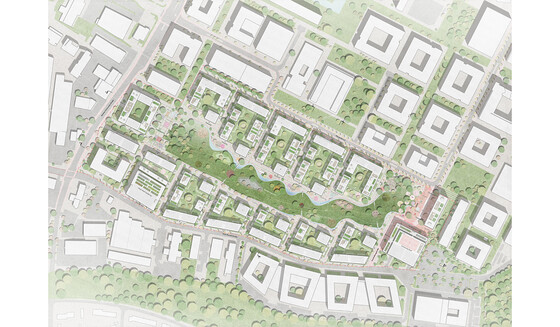
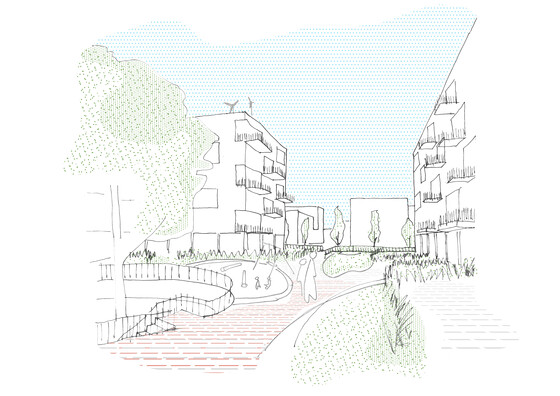
The addition of housing continues the precise block structure of the existing masterplan, matching its scale and height, while transforming it into a residential typology along the park — evolving from solid urban blocks to more open buildings in a green setting. While urban life in dense European cities usually unfolds along streets and squares animated by mixed uses, activity on the Siemens Campus is more episodic, tied to working hours and specific places. The new Siemens Garden, with its promenades and natural character, gives the residential areas a new sense of quality and identity. It introduces a form of landscape-based urban living, a calm and generous space at the center of the campus.
Siemens Garden
Here, the strict geometry of the street grid gives way to nature. The garden sweeps across the site, linking the representative buildings on Günther-Scharowsky-Straße with the Friedrich-Alexander University and connecting the entire campus along its path. The Siemens Garden is not filled with programmed uses — it simply offers what nature does: space to pause, to walk, to play ball on a mown field, to have a picnic, to follow small paths through grass and trees. Meadows, trees, shrubs, perennials and wildlife shape a quiet, generous landscape at the heart of the campus.
Promenades
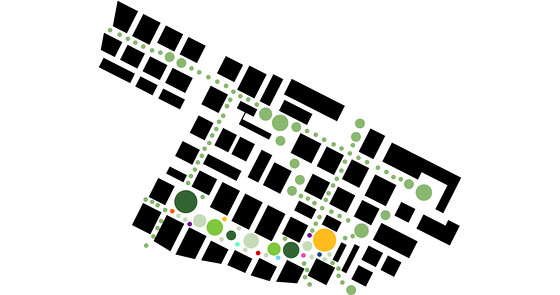
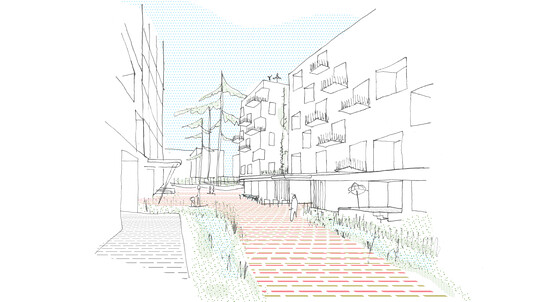
Between the western entrance square with its urban functions and the eastern neighborhood plaza with its student character stretches a promenade lined with small shops, a café and a bakery, as well as lively outdoor spaces with boules, table tennis and play areas for all ages. It is a place to stroll from one end to the other, to meet people and to be seen. Office workers, researchers, students and residents come together here, creating a vibrant park district full of everyday life.
Neighborhood Lanes and Mobility
Because distances on the Siemens Campus are short, walking and cycling take priority. Car traffic is limited to local access serving the above-ground garages within each block.
The streets become neighborhood lanes — calm, low-traffic spaces that still allow service vehicles, waste collection, deliveries, fire access and barrier-free movement, but primarily serve as places of encounter and shared use for residents.
Climate Resilience
Cooling the Campus
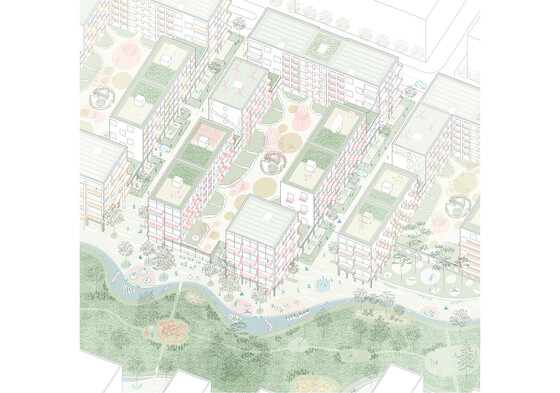
The Siemens Garden helps cool the efficiently used campus with its large unpaved, vegetated areas, as well as green roofs and façades.
Sponge City Principle
All rainwater is retained, absorbed or allowed to evaporate on site. Roofs are designed as green retention roofs with photovoltaic panels, which provide delayed irrigation for plants, improve the microclimate and prevent overheating. Surface water from the neighborhood lanes drains into shallow swales; water from the promenade and park loop collects in a visible water feature, which can be experienced and played with. Some of the water evaporates, cooling the air, while the rest seeps into the soil to water the vegetation. The natural Siemens Garden buffers heavy rainfall, temporarily storing water across its surface before letting it slowly soak away.
Competition: 2024
Client: Siemens Campus Erlangen Grundstücks GmbH
Landscape: friedburg & Co. Landschaftsarchitektur, Berlin